Clynce Support
Online
Clynce Support
It's Not the Answer Most People Expect — Why the Word "Green" on a Label Tells You Almost Nothing on Its Own, and the One Detail That Actually Predicts Cleaner Indoor Air
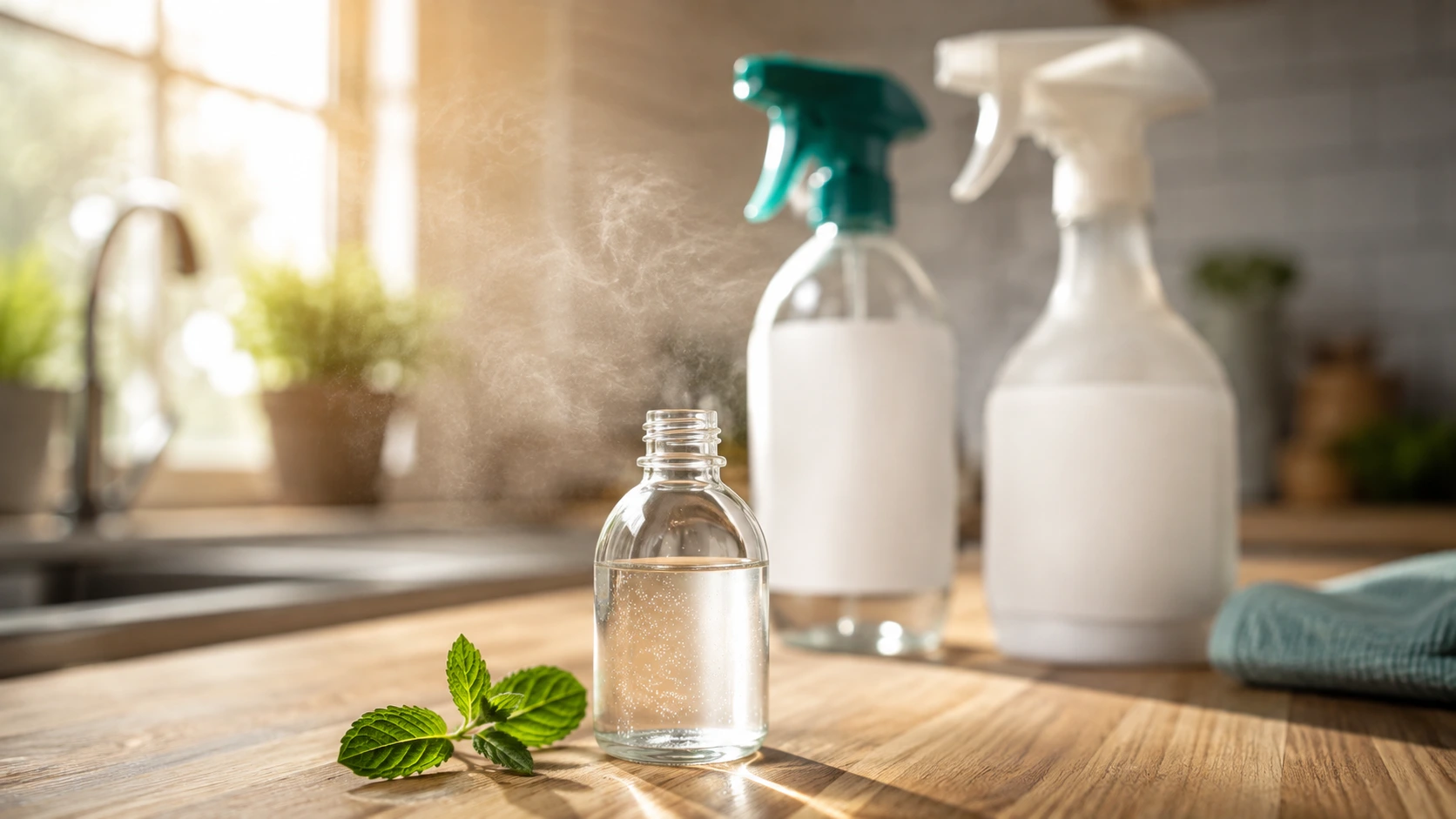
"Eco-friendly" on a cleaning product label feels like a straightforward promise — better for the planet, and gentler on the air inside your own home. It's a reasonable assumption, and it's also one that recent research has genuinely complicated. Multiple studies published in the past couple of years have tested exactly this assumption directly, comparing the actual chemical emissions of products marketed as "green" against conventional ones. The results are more interesting, and more useful, than a simple yes or no.
This matters for anyone choosing products for their own home, and it matters just as much when deciding what to ask a professional cleaner to use in it.
The Short Answer: Not automatically, no. Research has found that many products labelled "eco-friendly" or "green" emit similar levels of volatile organic compounds (VOCs) to conventional products — in some cases more, largely due to fragrance ingredients. The label that actually correlates with lower emissions isn't "green" or "natural" — it's specifically "fragrance-free."
This isn't a single study or a minor footnote — it's a pattern that's shown up across several independent pieces of research in the past two years.
�� Research: A University of York study published by the Royal Society of Chemistry compared the volatile organic compound emissions of ten conventional cleaning products against thirteen products marketed as "green." The researchers found no strong evidence that the green products were better for indoor air quality — and the green products often released more monoterpenes, a compound that can react indoors to form secondary pollutants including formaldehyde.
16–24 the number of volatile, potentially harmful ingredients identified in cleaning products carrying the official EU Ecolabel — a certification specifically intended to signal environmental and health safety — in a separate chemistry review of commercially available "green" products.
A separate, larger study published in the journal Chemosphere tested common household cleaning products and detected close to 200 hazardous volatile organic compounds across the sample, including known carcinogens. It found something more specific and genuinely useful: products broadly marketed as "green" weren't reliably lower in hazardous VOCs — but products specifically labelled "fragrance-free" were consistently associated with the fewest hazardous emissions of any group tested.
The explanation comes down to a specific, slightly counterintuitive detail: fragrance, particularly from natural sources, is one of the biggest drivers of the exact chemical emissions people are usually trying to avoid.
● Essential oils and plant-based fragrances contain monoterpenes: compounds that give many "natural" cleaning products their distinctive scent — and these are a genuine, measurable source of volatile organic compound emissions.
● Monoterpenes react with indoor ozone: this reaction can produce secondary pollutants, including formaldehyde, meaning a naturally-scented product can indirectly generate the very type of chemical it's often marketed as avoiding.
● "Green" is a marketing term, not a regulated safety standard: a product can reasonably be marketed as green based on packaging, plant-based surfactants, or environmental claims, without that label saying anything specific about airborne chemical emissions.
�� Worth Knowing: None of this means "green" products are somehow worse than conventional ones as a rule — the research found real variation within both categories. It means the word "eco-friendly" alone isn't a reliable signal of lower indoor air impact, and shouldn't be treated as one without more specific information.
Label or Claim | What the Research Suggests |
"Eco-friendly" / "Green" (general marketing claim) | Not a reliable predictor of lower VOC emissions on its own |
"Fragrance-free" | Consistently associated with the lowest hazardous VOC emissions across recent testing |
Heavily scented, including "natural" scents | Often a meaningful source of monoterpene emissions, regardless of the scent's origin |
Third-party certification (e.g. EU Ecolabel, Green Seal) | A useful signal, but not a guarantee — tested Ecolabel products still contained multiple volatile ingredients |
Good ventilation during and after cleaning | One of the most effective, universally recommended ways to reduce indoor VOC concentration, regardless of product choice |
✅ Good to Know: If reducing airborne chemical exposure is the main goal, choosing a fragrance-free product — green or conventional — and cleaning with windows open where possible are the two changes best supported by the current research.
This research doesn't mean requesting environmentally-friendly products is pointless — it means the reasoning worth having in mind is slightly different to "it's automatically safer to breathe."
● Genuine environmental reasons still hold: biodegradability, packaging, and reduced water pollution from certain formulations are separate questions to indoor air quality, and remain valid reasons to prefer these products.
● Surface and material safety can differ: some eco-formulated products are gentler on specific surfaces, which may matter more than air quality for certain homes.
● Personal sensitivity varies: some people are more reactive to specific synthetic fragrance compounds than natural ones, or vice versa — this is genuinely individual, and worth factoring in alongside the general research.
● Fragrance-free is the detail worth prioritising: if reducing chemical exposure indoors specifically is the goal, requesting fragrance-free products — rather than simply "eco-friendly" ones — is the more evidence-backed request to make.
�� Simple Rule of Thumb: A useful, specific request to make when booking a clean is "fragrance-free products where possible" rather than just "eco-friendly products" — it's a small wording change, but it's the detail the research actually points to.
Does this mean eco-friendly products are a waste of money?
Not at all — it means their main benefit, based on current research, is more reliably environmental than respiratory. If indoor air quality specifically is the priority, fragrance-free is the more directly supported choice.
Are essential oil-based cleaners bad for you?
Not inherently — but the research shows they're a genuine source of the same category of airborne compounds people are often trying to avoid by choosing "natural" products. Moderation and ventilation matter regardless of the fragrance source.
What should I ask my cleaner if I have asthma or sensitivities?
Be specific: request fragrance-free products, and mention any known sensitivities directly in your booking notes. A reputable business can generally accommodate this without difficulty when it's communicated clearly upfront.
Is there any product type the research consistently supports?
Fragrance-free formulations, of either conventional or green origin, are the most consistent finding across the recent studies. Beyond that, good ventilation during and after cleaning is one of the simplest, most universally effective changes available.
☐ Request fragrance-free products specifically, not just "eco-friendly"
☐ Mention any known sensitivities or asthma directly in the booking notes
☐ Ask whether windows can be opened during the clean, if that's practical for your home
☐ Don't assume a "green" label alone means lower chemical exposure
☐ Consider environmental factors (packaging, biodegradability) as a separate, valid reason to prefer eco products, distinct from air quality
The honest answer here is a genuinely useful one, even though it complicates a simple assumption: "eco-friendly" is a real and often meaningful claim, but it isn't a shortcut to better indoor air on its own. Knowing the more specific, better-supported detail — fragrance-free — means asking for exactly what actually matters, rather than a label that sounds right but doesn't guarantee it.
On Cleynce, booking notes go directly to your chosen business before the job starts — so a specific request like fragrance-free products, or any sensitivity worth knowing about, is communicated clearly from the very first booking, not left to guesswork on the day.
Written by
Unika

Trust and Safety · 8/31/2026
Everything You Need to Know Before You Book — From Spotting Red Flags to Comparing Quotes to Getting the Results You're Actually Paying For
Unika
Trust and Safety · 8/17/2026
Unika

Trust and Safety · 8/16/2026
Share your cleaning requirement in minutes, compare verified providers near you, and pay only for the service you choose.
Fast onboarding
Sign up, set preferences, and start in minutes.
Built for Growth
Whether it's a single booking or multiple sites, manage cleaning requests with ease.
The Real Psychology Behind Why So Many Capable, Hardworking People Feel Bad About Outsourcing Housework — And Why the Data Says That Guilt Is Working Against Their Own Wellbeing
Unika